
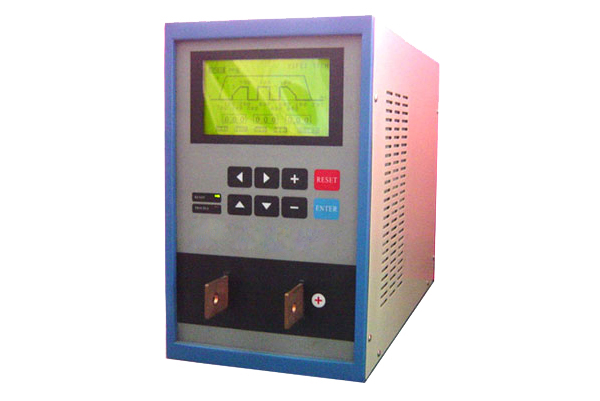
JIYI Inverter Spot Welding Machine
Key Features
Model: SMAPRO 260 (Inverter Type)
Inverter power supplies are a new type of power supply developed using IGBT inverter technology, microcomputer control technology, and modern power electronics technology. By employing AC-DC-AC conversion technology, time control achieves millisecond-level precision, significantly improving control response and accuracy. The DC output significantly improves welding processability.
Inverter technology also provides the equipment with a series of advantages, including compact size, high energy efficiency, fast response, and high performance. The use of microcontrollers and advanced electronic technology provides the equipment with excellent functions and precise control capabilities.
The SMAPRO 260 inverter power supply is suitable for spot welding non-ferrous metals such as copper and aluminum, alloy materials, precision parts, and high-quality products requiring accurate and consistent welding results.
Detailed Introduction
Inverter power supplies are a new type of power supply developed using IGBT inverter technology, microcomputer control technology, and modern power electronics technology. They are energy-saving and environmentally friendly.
By adopting AC-DC-AC conversion technology, time control achieves millisecond-level precision, greatly improving control response and accuracy. The DC output significantly improves welding processability and provides stable welding performance.
Inverter technology also gives the equipment advantages such as compact size, high energy efficiency, fast response, and reliable performance. The use of microcontrollers and electronic technology provides the equipment with advanced control, monitoring, protection, and parameter management functions.
The inverter power supply is suitable for spot welding of non-ferrous metals such as copper and aluminum, alloy materials, precision parts, and high-quality products.
Features of Inverter Electronic Spot Welding Machine
1 - Power Input: 220V, 50Hz, 2000VA (220V ±5V) / 115V, 60Hz, 2000VA (115V ±5V)
2 - Maximum Output Current: 4000A
3 - Welding Frequency: 120 times/minute
4 - Preheating Paint Removal Pulse Width: 1–9ms (1ms subdivision accuracy)
5 - Preheating Paint Removal Pulse Amplitude: 0.01–0.99V (0.01V subdivision accuracy)
6 - Welding Pulse Width: 1–999ms (1ms subdivision accuracy)
7 - Main Pulse Amplitude: 0.01–9.99V (0.01V subdivision accuracy)
8 - Welding Pressure: 30–3000g or 50–4500g (10g adjustment accuracy)
9 - Welding Wire Diameter: Φ0.02mm–Φ1.50mm
10 - Product Configuration: Available in two types: monocular microscope holder and stereomicroscope holder
11 - Microcontroller Control: MCU control with current, voltage, and power monitoring functions
12 - Transformer Bridge: Adopts soft-switching technology to reduce switching losses and electromagnetic interference
13 - Fault Diagnosis and Alarm: Provides fault diagnosis and alarm functions for abnormal current, excessive monitoring values, excessive mains voltage, and overheating
14 - Bridge Protection: Automatic shutdown in case of abnormal bridge current enhances system protection
15 - Heating Control: Three-stage heating settings with current ramp-up and ramp-down functions, with a wide time setting range of 0–250ms, suitable for complex welding processes
16 - Parameter Storage: Four sets of parameters can be stored for convenient use with different welding techniques
17 - Display Options: Available with a 7-inch touchscreen display or a 240 × 128 LCD screen, both capable of displaying multiple contents simultaneously
18 - External Communication: Provides welding-end, fault, and counting signals, with an optional RS-232 data communication port to facilitate automated welding
19 - Start and Output Signals: Four sets of start input signals supporting a maximum of 15 welding parameters, along with three sets of output drive signals for multi-head operation
20 - Data Storage: Uses EEPROM data storage, eliminating battery life limitations
21 - Fast Response Speed: The power-on time control cycle is 0.25ms, which is approximately 80 times faster than the 20ms cycle of a typical AC welding machine
22 - Operating Modes: Three operating modes are available: constant current, constant voltage, and constant power
23 - Welding Consistency: Constant current, constant voltage, and constant power control greatly improves welding consistency and reduces spatter to a minimum
24 - Preheating Slow-Rise Function: Each pulse can be individually configured to ensure a uniform temperature rise from cold to hot on the welded workpiece, resulting in a stronger and more consistent weld
25 - External Dimensions: 260 × 380 × 290mm
26 - Total Weight: 30kg
Performance
High Precision
Build Standard
Industrial Grade